
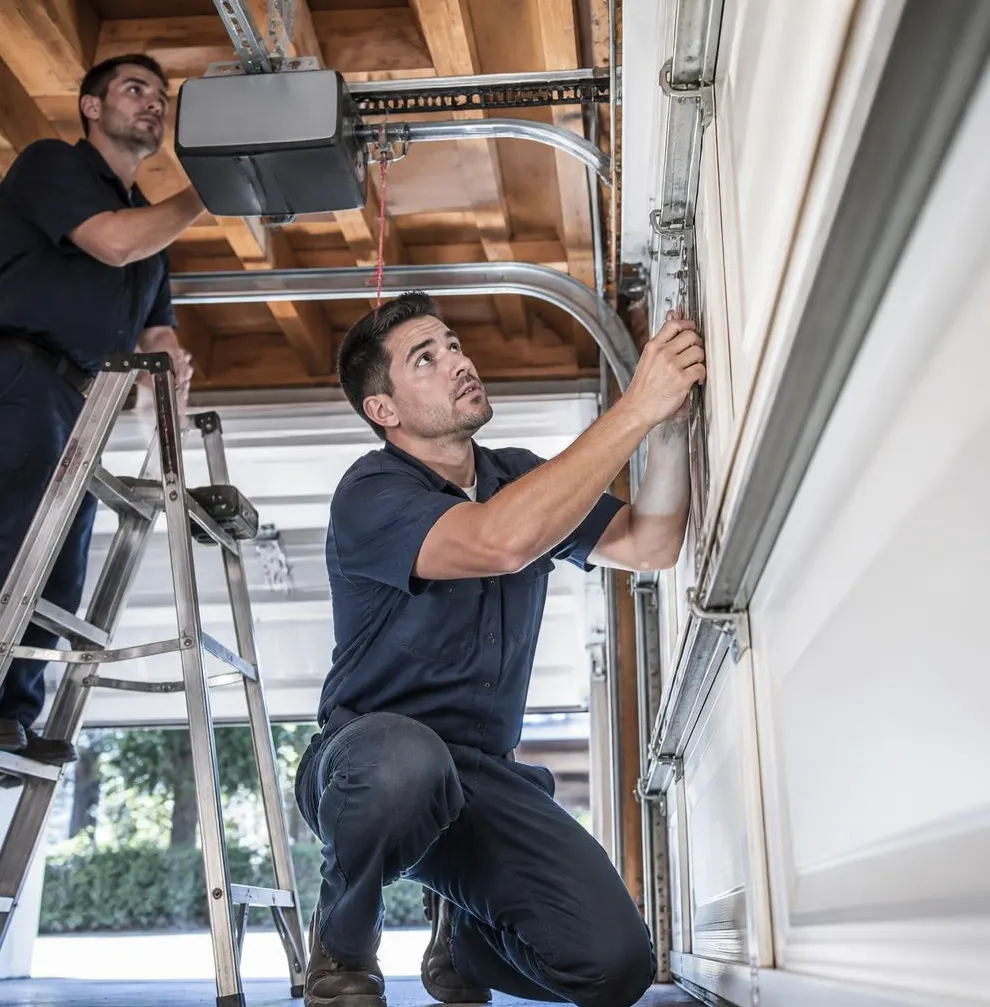
What a Technician Sees on These Calls
The call usually comes in the day after a bad blow: a homeowner opens the garage to find the door bowed inward, a panel cracked along a seam, or the whole door sitting crooked on its tracks. Sometimes it's worse — the door has come off the track entirely and is resting against a car or the back wall. In almost every case, the signs were there weeks earlier: a roller that squealed on the way up, a slight sag at the bottom corner, rust creeping along the track where humidity and salt air have been working on the metal. Nobody thought a loose hinge or a stiff spring had anything to do with wind resistance. It does.
Why the Garage Door Takes the Hit First
A garage door is the largest moving opening in most homes, and it's built differently than a wall. Walls are rigid and braced in multiple directions. A garage door is a series of hinged panels held in place by tracks, rollers, and a spring system that's balanced for lifting weight — not for resisting a sustained push from outside. When wind hits the front of a house during a tropical storm or hurricane, pressure builds up inside the garage if the door fails even slightly. That internal pressure pushes up on the roof and out on the walls from the inside, which is why engineers consider the garage door the weakest point in a home's envelope. Once it goes, the rest of the structure is fighting a losing battle.
The Local Factors That Make This Worse
- Humidity and swelling: Wood and composite panels absorb moisture in Florida's humid air, which can warp panels slightly and throw off how evenly the door seats in its frame.
- Salt air corrosion: Homes closer to the coast see faster rust on tracks, hinges, and spring coils, which weakens hardware exactly where it needs to hold under load.
- Afternoon downpours: Sudden heavy rain can reveal gaps at the bottom seal or sides that let water in, a sign the door isn't sealing tightly — which also means it's not seated as securely as it should be against wind pressure.
Pre-Storm Checks Worth Doing Now
Before storm season ramps up further, walk through these checks. None require taking the door apart.
- Inspect the tracks and rollers. Look for rust, bent sections, or rollers that wobble instead of rolling smoothly. A track that's even slightly out of alignment lets the door shift under pressure instead of staying locked in place.
- Check the springs. A door with a weakened or unbalanced spring won't open evenly and puts extra strain on the opener and track during high wind, since the door isn't moving or sitting the way it was designed to.
- Test the auto-reverse and opener connection. During storms, power can flicker before it goes out fully. Make sure the opener responds correctly and that you know how to disconnect it and operate the door manually if needed.
- Look at the panels themselves. Cracks, dents, or delamination (common after a few humid seasons) weaken the structural integrity of the door as a whole, not just the look of it.
- Check for wind-rated bracing. Some doors have horizontal struts on the back side designed to stiffen the panels against wind load. If your door doesn't have these and you're in an area that sees regular tropical storm activity, it's worth asking whether retrofitting is possible or whether the door should be replaced with one rated for higher wind pressure.
A Note on Backup Power
If you rely on an opener with no manual backup plan, a power outage mid-storm can leave you unable to close the door at all if it was open, or unable to get a car out before you need to evacuate. Keep the manual release cord accessible and test it before storm season, not during it.
When to Call Oneco Garage Door Service
If you notice rust on the tracks, a door that doesn't sit flush, or panels that look warped or cracked, that's the point to call rather than wait. A Garage Door Tune-Up & Maintenance visit covers exactly the things storms exploit — track alignment, spring balance, roller condition, and hardware corrosion — and catches problems while they're still cheap fixes. If the door itself is aging, undersized for current wind-load expectations, or has taken damage in a past storm, a New Garage Door Installation with wind-rated construction is the more permanent fix, especially for homes closer to the coast dealing with heavier salt exposure. Either way, we show up, give you a straight read on what's actually wrong, and fix it without upselling you on work the door doesn't need.
If storm season has you wondering whether your garage door will hold, call Oneco Garage Door Service. We serve Oneco, Bradenton, Sarasota, Palmetto, Ellenton, Lakewood Ranch, Bayshore Gardens, and Cortez, and we can usually get a technician out fast to check your door before the next system rolls in.